George Boleyn
Wolf HallGeorge Boleyn, Lord Rochford, is Anne Boleyn’s brother and one of the figures through whom the novel connects family loyalty, courtly display, and the political struggles surrounding Henry VIII’s court. A polished, witty young courtier, he moves between the intimate circle around Anne and the public business of the realm. His attention to clothes and performance is set against moments when his family’s precarious position demands practical judgment and intervention.
Identity and Courtly Presence
George appears as an educated and socially assured member of Anne’s circle. The narrator calls him witty, polished, and well read, but in one conversation about the obligations binding rulers and subjects, and husbands and wives, George is absorbed by the flame-coloured satin puffed through his slashed velvet sleeve. He coaxes the fabric into larger folds with a fingertip. The detail makes courtly appearance more than decoration: George’s cultivated self-presentation is part of the world in which political authority and personal standing are continually displayed.
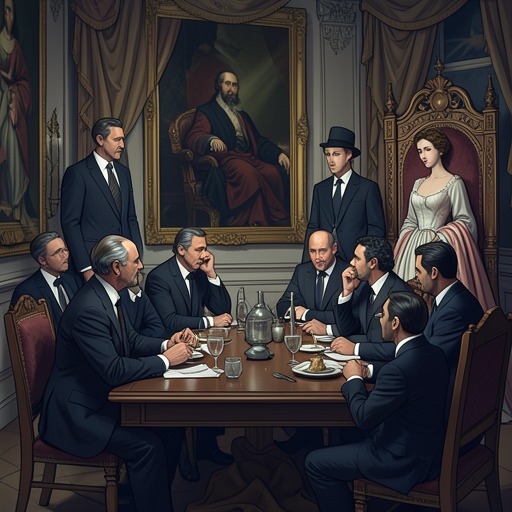
His clothing recurs as a measure of mood and status. At a tense family meeting over Anne’s past, his sleeves are only moderately puffed; seated beside his father, Thomas Boleyn, he holds his head in his hands. Later, while the family weighs what to do, he removes his cap and tests its jewelled pin against his finger. These small gestures place him within the court’s language of fashion and rank, but they also show a young man absorbed in thought as the Boleyn family’s fortunes come under pressure.
Anne’s Political Crisis
George is present when Anne’s past relationship with Henry Percy becomes an urgent political problem. The king has ordered an inquiry, and the family fears that Percy’s testimony could revive allegations of a secret marriage. Thomas Boleyn, the Duke of Norfolk, Jane Rochford, Mary Boleyn, and Anne gather to consider their response. George asks that the door be shut and no one else admitted, then warns Jane against continuing to suggest that Anne should be sent away. His intervention does not settle the dispute, but it reveals his awareness that words spoken in the room may worsen an already dangerous situation.
As Anne denies a binding promise or contract, George tries to make Percy’s past acquiescence useful to her present case: Percy had once been persuaded to abandon his claims, he points out, and might be persuaded again. Anne answers that it was the cardinal who managed that before, and he is dead. The exchange makes George’s political task plain. He is trying to find a workable approach for his sister in a crisis where the family can no longer rely on the former cardinal’s influence, while Norfolk presses for immediate action and Thomas Boleyn hesitates over his options.
The episode also shows George responding to the room through objects and gestures. After the argument, he takes off his cap and plays with its jewelled pin; he pricks his finger. The scene offers no decisive resolution from him, but his effort to mediate between Anne’s denial, his father’s caution, and Norfolk’s anger establishes him as a participant in family strategy rather than a distant observer.
Family and Courtly Alliances
George’s position is closely tied to Anne’s. At court, she has made the king’s friends, including Henry Norris and William Brereton, part of her own circle, and George is among the men gathered around her. In the account of a court performance mocking Thomas Wolsey, George takes the part of a hand-devil alongside Norris. Their role is to seize the cardinal in the staged descent into hell. Behind the screens, the players strip off their costumes and recover from the performance; George jokes that one of the devil garments is like the shirt of Nessus. The scene links his public amusements to the factional culture of the court, where a former minister’s fall can be made into entertainment.
His family ties also shape his place in Mary Boleyn’s departure from court. When Mary’s marriage to William Stafford becomes known, George is away in Paris. Mary says that her brother will help her when he returns, but Jane Rochford doubts that he will intervene on behalf of a sister who has, in her view, disgraced the family. The scene does not establish what George later does. It instead sets his absence against Mary’s expectation of kinship support and the competing judgment that family reputation may outweigh personal loyalty.
George also appears in the political aftermath of Mary’s marriage as one of the king’s representatives at the executions of the London Charterhouse monks. The assignment places him alongside his father and Norfolk at a public spectacle intended to demonstrate the consequences of refusing the required oath. He is thus associated not only with Anne’s private and dynastic affairs, but with the government’s visible enforcement of its religious settlement.
Parliament and More’s Trial
George’s courtly role enters the legal drama at Thomas More’s trial. During the proceedings, he leans forward and asks More to give his own version of the conversation reported by Richard Riche. More replies that he made no written note because his writing materials had been taken away, and that this was why Riche had come to him. George’s question gives More an opportunity to address the jury, but the jury’s stony response leaves uncertain whether the intervention has helped him.
The episode places George among the listeners and decision-makers trying to turn disputed words into a legally actionable case. More’s account emphasizes the distinction between temporal authority, which Parliament may determine, and spiritual jurisdiction, which he considers beyond Parliament’s power. The surrounding proceedings show how the government’s claims and More’s conscience collide; George’s contribution is a pointed request for the prisoner’s account, not a complete resolution of that conflict.
George’s importance therefore lies partly in his position between intimate family politics and institutional power. He is Anne’s brother, a courtier whose appearance and wit are carefully observed, and a participant in both the management of her political crisis and the public proceedings against those who resist the king’s religious authority. The novel gives him distinct moments of judgment and intervention, while leaving the larger outcome of his family’s fortunes unsettled in these scenes.